WHERE THE SEA BEGINS
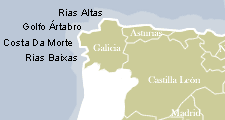
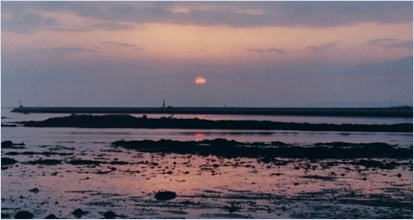
Facing this tempestuous sea, we Galicians feel all Europe
at our back. You will find the continent’s highest
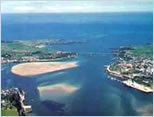
cliffs here, but also a fertile union of sea and land
which are the rias, remarkable formations where the
ocean calms and penetrates inland to bring life, which
flows along the fishing villages and the uncountable
sandy beaches along the coastline. It is here, between
the bends and twists that characterises the baroque
geography of our shores, where most of the Galicians
live, taking a thousand and one flavours from the sea,
a wealth of fish and shellfish, which the Atlantic waters
turn into the most delicious in the world.
HUMANISED LAND
There are old prominent hills worn down by erosion and
lush valleys carved out by a thousand rivers. There
is the light green of the meadows, the emerald green
of the crops and the dark green of the forests. Here
and there, there are small properties, a potato farm,
a maize farm, not forgetting the market gardens and
the vineyards, which dominate the shores of the biggest
rivers. On the hills the forest with in the middle prairies,
where cows are grazing, agricultural Galicia’s
most typical animal. This is a landscape that we Galicians
like to call humanised, where the distance between towns
is not great, and where uninhabited spots are never
very large. In the remotest spots are the briars, the
ancient, mysterious forest.
THE FORGES OF STRENGHT
Farm labouring blood still runs through the streets
of the cities and the big towns; our grandparents had
come from the country. Ninety per cent of Galicia’s
population lived in a rural environment up to 1900,
but nowadays, most of us live in the urban world, and
it is in the towns and cities that grew up around the
marvellously beautiful historic centres where the countries
economic and cultural creativity is based. In the case
of the ancient city of Santiago de Compostela –
the historic and administrative capital – it gets
universal values. Overlooking the sea, Coruña
and Vigo are the biggest cities; Lugo, Ourense, Pontevedra
and Ferrol maintain industrial and service activities
beside their traditional administrative function. All
over Galicia, the medieval towns conserve their charm,
developing at the same time as those that appeared in
the 19th century, combining new industrial functions
with their role in the regions.
A ROAD TO THE STARS
Since ancient times people had
followed the route of the sun to the west. At night,
a stream of stars in the sky pointed in the same direction,
the Milky Way, also known as St. James’ Way or
the Pilgrim’s Way, since it was the way to follow
for people on pilgrimage to Santiago de Compostela.
From the 9th century, pilgrims walked the roads of Europe
on foot: in the 12th century, a figure of five-hundred
thousand is estimated, and in the year 1999 five and
a half million people arrived in Santiago de Compostela,
Galicia. Throughout history, the aim of the journey
was to visit the tomb of St. James the Great, one of
the twelve apostles of Christ, who, as tradition believes,
would be entombed in the cathedral of our country’s
capital. Today, reasons for the pilgrimage are varied,
from spiritual to artistic, but the Way continues to
be a powerful cultural melting pot for the lands of
Europe.
|